Java Full Stack
Built for real work.
Learn Java Full Stack development in Telugu with the combined ReactJS and Java Spring Boot curriculum. Recorded lessons cover frontend interfaces, backend APIs, MySQL, authentication, payments and deployment. Personal doubt and error support is included throughout your purchased access period.
Understand the course, teaching approach, and learning experience.
Build skills you can actually use.
Frontend to backend
Build React interfaces and connect them to Spring Boot APIs.
Complete e-commerce flows
Connect accounts, product catalogs, shopping carts, and database operations.
Secure, practical features
Authentication, authorization, uploads, payments, and error handling across the application.
Build, deploy, and explain
Deploy projects, use AI tools thoughtfully, and prepare your portfolio and interview answers.
Tools you’ll work with
Who is this course for?
Start with HTML, CSS and JavaScript for the frontend, and Java and SQL for the backend. The course combines both learning paths before connecting React interfaces to Spring Boot APIs.
Complete applications: React frontend, Java Spring Boot backend, MySQL, integration and deployment.
Compare the learning paths →
Anji Reddy Co-Founder & Trainer
10+ years of industry experience across Infosys, QuickRide and SBD Automotive. Practical software skills, explained in Telugu.
Meet your trainerKnow exactly what you’ll learn.
11 modules · 247 topics · Recorded in Telugu
01HTML21 topics+
- Introduction
- HTML page syntax
- Create an HTML page and check the output
- HTML, head, and body tags
- Heading and paragraph tags
- Attributes
- Images: display, height, and width
- Ordered lists
- Unordered lists
- Tables: rows and columns
- Forms: text, password, email, date, and file inputs
- Forms: dropdowns
- Forms: radio buttons, checkboxes, and textareas
- Buttons
- Style tag
- Import CSS with the link tag
- Import JavaScript with the script tag
- Class and ID attributes
- Div tags: divide a page into blocks
- Meta tags: title, description, and keywords
- Meta tags for SEO and social sharing: Facebook, Twitter, and Google
02CSS17 topics+
- Colors: hexadecimal, RGB, and RGBA
- Fonts: family, color, and size
- Apply colors to HTML tags
- Apply colors using class and ID selectors
- Image styles: width, height, and auto
- Width and height
- Borders: radius and color
- Padding
- Margin
- Background colors
- Shadows
- Flexbox
- Alignment
- Positioning
- Grid
- Using new fonts
- Font Awesome icons
03Bootstrap13 topics+
- Bootstrap introduction
- Using Bootstrap in ReactJS
- Page layout: rows and columns
- Navigation
- Forms
- Tables
- Text formatting
- Cards
- Text colors
- Background colors
- Modal popups
- Tooltips
- Alerts
04JavaScript51 topics+
- Introduction
- Local setup: Node.js and Visual Studio Code
- Write your first JavaScript code and check the output
- Variables introduction
- let, var, and const
- Strings and string methods
- Practice strings
- Numbers
- Booleans
- Convert strings to numbers and numbers to strings
- JSON objects
- Practice JSON objects
- Arrays: strings, numbers, and mixed values
- Access and update array values
- Access and update JSON arrays
- For loops
- While loops
- Do-while loops
- forEach loops
- Break and continue
- Practice loops
- Comparison operators: equality, greater than, less than, and more
- Logical operators: AND, OR, and NOT
- Conditional operator
- If-else conditions
- Switch statements
- Array map function
- Array filter function
- Array sort function
- Practice array functions
- Functions and methods
- Arrow functions
- Classes and the this keyword
- Modules
- Import and export
- Practice functions and classes
- Callbacks
- Promises
- Async and await
- Practice callbacks and async/await
- Error handling
- Working with dates
- Practice real-world concepts
- Real-world use cases with strings
- Real-world use cases with numbers
- Real-world use cases with JSON objects
- Filter JSON arrays
- Update JSON arrays
- Data validation: forms and API inputs
- If-else conditions in practice
- Working with arrays
05ReactJS32 topics+
- Introduction
- Create a ReactJS project
- Run the project and check browser output
- Explore project folders
- Create a React component with JavaScript and HTML
- Display a React component in the browser
- Use state variables
- Display JavaScript variable data in HTML
- JSX syntax and rules
- Create a page with multiple components
- NPM: install, update, and delete packages
- Create multiple pages and navigation with React Router
- Homepage design: navigation, content, footer, images, headings, paragraphs, rows, and columns
- Forms: name, email, password, dropdowns, radio buttons, checkboxes, and buttons
- Read form data into JavaScript variables
- Data validation and displaying errors
- API introduction: Fetch API and Axios
- Handle API errors and read responses
- Local storage: store and retrieve browser data
- API practice: login, signup, and contact forms
- How login works: login, logout, and cookies
- useEffect and useRef
- Pass data from parent to child and child to parent
- E-commerce product listing page
- Single product page
- Update profile page
- Add, update, delete, and view addresses
- Display API response data in HTML tables
- Redux: setup, store, and retrieve data
- File uploads: images, documents, and validation
- Build a project
- Deploy the project to a server
06Java38 topics+
- Introduction to backend development
- Install Java, Eclipse, and VS Code; configure environment paths
- Write and execute Java code
- Classes and methods
- Variables and data types
- Strings and string methods
- Numbers: int and float
- Post-increment and pre-increment
- Post-decrement and pre-decrement
- Booleans
- Arithmetic operators: addition, subtraction, multiplication, division, and remainder
- Comparison operators: less than, greater than, equality, and inequality
- Logical operators: AND, OR, and NOT
- If-else conditions
- Nested if-else
- Switch statements
- For loops
- While loops
- Do-while loops
- Break and continue
- Object-oriented programming introduction
- Classes and constructors
- Objects and calling methods
- Inheritance
- Method overloading
- Method overriding
- Access modifiers: private, public, and protected
- Abstract classes and methods
- Interfaces
- ArrayList
- LinkedList
- HashMap
- HashSet
- Exception handling
- Threads
- Working with dates
- File handling
- Stream API
07SQL & MySQL19 topics+
- Database introduction, installation, and table creation
- Data types
- Primary keys and auto-increment
- Insert, update, and delete data
- WHERE, AND, OR, NOT, IN, LIKE, and LIMIT
- MIN, MAX, COUNT, AVG, and SUM
- Left, right, and inner joins
- UNION and UNION ALL
- GROUP BY and HAVING
- CASE statements
- Stored procedures
- ALTER TABLE: columns and data types
- TRUNCATE and DELETE
- Constraints: NULL, NOT NULL, UNIQUE, and CHECK
- Design tables for e-commerce, college, and other use cases
- Foreign keys
- Create indexes
- Working with dates
- Export and import tables, data, and stored procedures
08Spring Boot29 topics+
- Introduction, Spring Tool Suite, and project setup
- Run a project
- Annotations
- Folder structure: controller, service, entity, and POJO
- Dependency injection
- REST controllers
- GET APIs
- POST APIs
- PUT, DELETE, and PATCH APIs
- Lombok and POJO classes for POST, PUT, DELETE, and PATCH
- Receive data and validate inputs
- Responses: errors and data
- Sending emails
- Spring Data JPA: tables, queries, select, insert, update, delete, and stored procedures
- Read HTTP headers and cookies
- Login and signup APIs
- Forgot password and update password APIs
- E-commerce APIs: products, single products, comments, and reviews
- File uploads: images, PDFs, ZIP files, cloud uploads, and validation
- JWT tokens
- Logging
- Create and use microservices
- Spring Boot Actuator
- Swagger
- WAR and JAR files for deployment
- Deploy on AWS
- Schedulers
- Call external APIs from the backend
- Build an e-commerce backend
09Git & GitHub11 topics+
- What is Git and GitHub
- Install Git
- Create a repository
- Clone a project to your system
- Create, delete, and rename branches
- Add files to tracking
- Commit code
- Push and pull
- Create pull requests and merge branches
- Merge branches
- Resolve merge conflicts
10Job assistance4 topics+
- Interview preparation
- Mock interviews
- Resume preparation
- LinkedIn and Naukri profile setup
11AI & Spring AI12 topics+
- AI vs ML vs GenAI vs agents
- How ChatGPT and LLMs work
- Hallucinations, incorrect code, and security risks
- Writing effective prompts
- Role-based prompting
- Structured prompts
- Using Codex and Claude
- Project development using prompts
- Code review, updates, and bug fixes
- Spring AI
- AI integration without Spring AI
- AI integration with Spring AI
Java Full Stack course questions
What will I learn in the Java Full Stack course?
Learn Java Full Stack development in Telugu with the combined ReactJS and Java Spring Boot curriculum. Recorded lessons cover frontend interfaces, backend APIs, MySQL, authentication, payments and deployment. Personal doubt and error support is included throughout your purchased access period.
Where should I start?
Start with HTML, CSS and JavaScript for the frontend, and Java and SQL for the backend. The course combines both learning paths before connecting React interfaces to Spring Boot APIs.
What is the Java Full Stack course fee?
The fee is ₹8,999 for three years, or ₹13,999 for lifetime access. Prices are in INR and include applicable taxes. Doubt and error support is included throughout the selected period.
Can I upgrade to lifetime access later?
Yes. While your paid course access is active, eligible learners can upgrade in My Learning by paying the current lifetime price minus their original payment, including any original discount. Upgrades include lifetime course-related support, do not accept coupons and do not restart the original refund window. Contact support for migrated or manually granted access.
Are the courses live or recorded?
All courses use recorded lessons taught in Telugu. Learn at your own pace, revisit topics, and practise alongside the recordings.
How do I get help with doubts and coding errors?
Personal doubt and error support is available through WhatsApp and Zoom throughout your purchased access period. Share the problem you are working on and get guidance to understand and resolve it.
How long can I access the course and support?
Choose three years or lifetime access when purchasing. Course access and doubt support are included for the full selected period.
Can I use my account on more than one device?
One login session is allowed at a time. Signing in on another device ends your previous sessions. Multiple tabs in the same browser can use the same session.
Is career preparation included?
The curriculum includes interview and resume preparation, with project development and guidance to help you explain your work. Student outcomes are individual experiences, not a promise of employment.
Can I view the syllabus and demo before purchasing?
Yes. The course introduction video and full syllabus are available on this page without signing in. Review the topics and teaching approach before choosing an access plan.
For purchase terms, read our terms and conditions and refund policy.
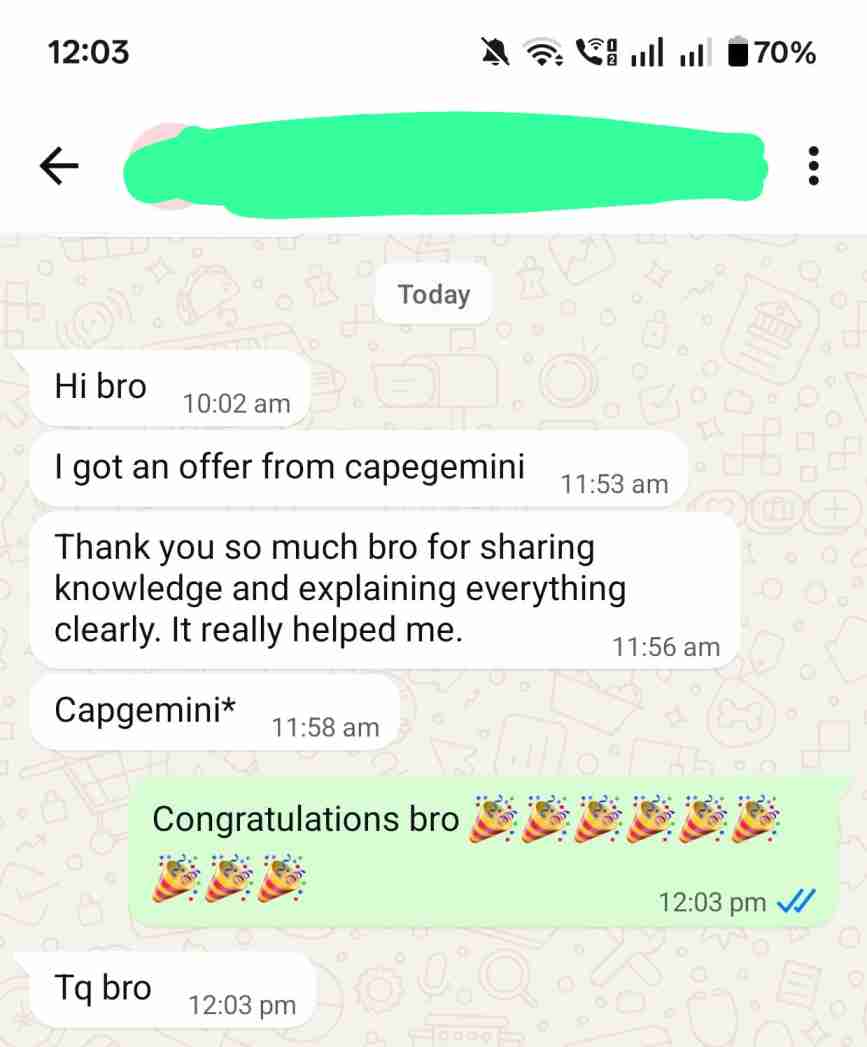
Real experiences.
Shared by our students.
In their own words. Open any screenshot to read it in full.